
HR
OLTARNA SLIKA PRESVETOG TROJSTVA
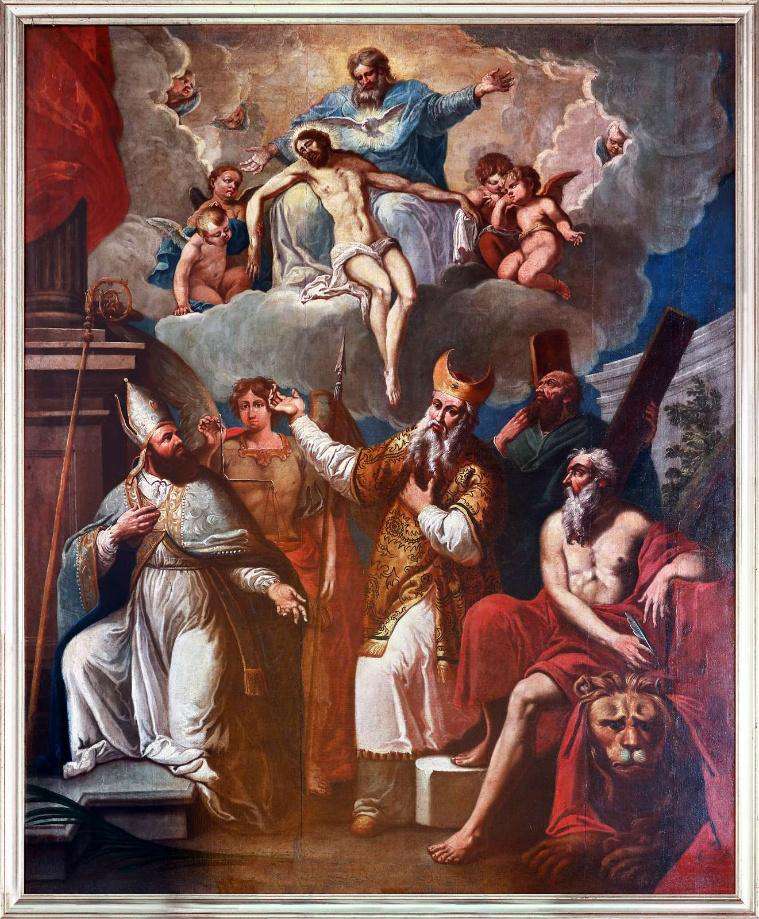
Oltarna slika glavnog oltara župne crkve Presvetog Trojstva rad je nepoznata baroknog autora venecijanske škole iz 17. st. Naslikana je tehnikom ulja na platnu. Zbog svog formata, originalna se slika nalazi na bočnom zidu crkve, a u retablu oltara njezina preslika manjeg formata.
U gornjem je dijelu slike prikaz Presvetog Trojstva: u nebeskoj stvarnosti, na oblacima, okruženi anđelima, nalaze se Bog Otac prikazan u liku starca odjevena u plavo, Bog Sin u liku Isusova beživotnog tijela skinuta s križa koje počiva u krilu Boga Oca i Bog Duh Sveti u liku goluba koji počinje svoj let iz prsiju Boga Oca. Ispod prikaza presvetog Trojstva, pod oblacima, smješteni u ambijent zemaljskog zdanja, nalaze se sveci zaštitnici Dalmacije. Gledajući sliku slijeva nadesno, prikazani su likovi: sv. Dujam, sv. Mihovil, sv. Šimun Bogoprimatelj, sv. Andrija i sv. Jeronim.
SV. DUJAM (DUJE)
Na lijevoj strani slike, u donjem lijevom kutu, nalazi se lik ranokršćanskog mučenika solinskog biskupa Dujma, ubijena za vrijeme cara Dioklecijana, zaštitnika grada Splita. Odjeven u svečano biskupsko ruho, s insignijom biskupskog štapa s desne strane i simbolom mučeništva, palminom granom, pod nogama, sv. Dujam je zagledan u Otajstvo Presvetog Trojstva. Zanimljivo je da se brdo na kojem se nalazi vrgadinska župna crkva i s kojeg ,,puca” jedan od najljepših pogleda na ovaj dio Dalmacije zove Sudujam (Sv. Dujam). Brdo je dobilo ime po ovom velikom dalmatinskom svecu čije su štovanje na Vrgadu donijeli njezini novopridošli stanovnici koji su oko 1069. naselili Vrgadu. U vrijeme kralja Tomislava 923. g. Vrgada prestaje biti dio Bizanta, a u vrijeme kralja Petra Krešimira IV. naseljava se hrvatskim stanovništvom koje joj daje ime Levigrad, kasnije Lapkat. Vjeruje se da su tadašnji stanovnici negdje na tom
brdu izgradili malu kapelicu posvećenu svom omiljenom svecu. ,,Kapelica” je inače i mjesni naziv za područje današnje župne crkve na brdu Sudujmu.
SV. ŠIMUN BOGOPRIMATELJ (sv. Šime)
U sredini se, s desnicom ispruženom prema Kristu čiju je smrt navijestio Blaženoj Djevici Mariji prije scene prikazanja Gospodinova u jeruzalemskom Hramu, nalazi lik sv. Šime, zaštitnika grada Zadra. Vrgada je 18. listopada 1421. prvi put dospjela u ruke zadarske plemićke obitelji, grofova Zloradis. Nakon njih pripadala je grofovima Farini, Klokočićima i na kraju grofovima Damiani. Zbog svoje administrativne usmjerenosti prema Zadru, središtu Nadbiskupije, sv. Šime zauzima središnje mjesto podno Presvetog Trojstva na oltarnoj slici.
SV. JERONIM (sv. Jere)
Lik sv. Jeronima, mistika i crkvenog naučitelja s kraja 4. i početka 5. st., nalazi se u donjem desnom kutu slike. Njegovo najveće djelo je prijevod Biblije s hebrejskog i grčkog na latinski jezik, poznat pod nazivom Biblia Vulgata. Napisao je mnoga značajna teološka djela, a s današnjom Dalmacijom ga veže naziv rimske provincije u kojoj je rođen. Sv. Jeronima posebno se povezivalo s Dalmacijom i jer se predstavljao kao ponosni Dalmatinac. Pripisuje mu se da je, svjestan svoje teške naravi, često znao reći: „Oprosti mi, Bože, jer sam Dalmatinac!“ Vrgadinska oltarna slika prikazuje sv. Jeronima pokraj lava koji mu je, prema legendi, ušao u špilju u kojoj je proučavao Bibliju i zatražio pomoć. Sv. Jeronim mu je hrabro izvadio trn iz šape, a lav mu je postao vjeran i krotak poput psa; noću bi odlazio u lov, a danju čuvao sv. Jeronima u špilji. Sv. Jeronim je inače nebeski zaštitnik Dalmacije.
SV. MIHOVIL, arkanđeo (sv. Mihael)
U pozadini sv. Dujma i sv. Šime nalazi se lik sv. Mihovila, arkanđela, zaštitnika grada Šibenika. Ikonografija prikazuje sv. Mihaela kao ratnika u oklopu i s mačem u ruci. Crkva od najstarijih vremena ima veliko štovanje i duboku pobožnost prema sv. Mihovilu. Promatra ga kao moćnog anđela, koji je svojom zaštitom trajno prisutan.
SV. ANDRIJA, apostol (sv. Jadre)
Titular male predromaničke crkve na vrgadinskom groblju, koja potječe iz davnog 9. stoljeća, je sv. Andrija. Inače je ovaj svetac zaštitnik ribara, a legenda kaže da je more upravo na to mjesto donijelo drveni kip sv. Andrije, apostola i mučenika, koji je bio raspet na križ u znaku slova X te se po njemu takav križ i naziva Andrijinim križem, a svetac ga na ovoj slici, smješten u pozadini sv. Jeronima, drži kao svoj ikonografski atribut. Crkva Sv. Andrije, koja danas služi kao kapelica na mjesnom groblju na Vrgadi, bila je župna crkva do 17. st. (do izgradnje današnje župne crkve).
ENG
ALTAR PAINTING OF THE HOLY TRINITY
The altar painting of the main altar of the parish church of the Holy Trinity is the work of an unknown Baroque artist of the Venetian school from the 17th century. It is painted in oil on
canvas. Due to its size, the original painting is located on the side wall of the church, while a smaller-format replica is found in the retable of the altar.
In the upper part of the painting is the depiction of the Holy Trinity: in the heavenly realm, on clouds, surrounded by angels, are God the Father, shown as an elderly man dressed in blue; God the Son, in the form of Jesus' lifeless body taken down from the cross, resting in the arms of God the Father; and the Holy Spirit, in the form of a dove, beginning its flight from the chest of God the Father. Below the depiction of the Holy Trinity, under the clouds, situated within an earthly setting, are the patron saints of Dalmatia. From left to right, the figures are: St. Domnius, St. Michael, St. Simeon the God-Receiver, St. Andrew, and St. Jerome.
ST. DOMNIUS (DUJE)
On the left side of the painting, in the lower left corner, is the figure of the early Christian martyr St. Domnius, the Bishop of Solin, who was martyred during the reign of Emperor Diocletian, the patron saint of the city of Split. Dressed in ceremonial episcopal attire, with the insignia of the bishop’s staff on the right and the symbol of martyrdom, a palm branch, at his feet, St. Domnius gazes at the mystery of the Holy Trinity. It is interesting that the hill on which the parish church of Vrgada is located, offering one of the most beautiful views of this part of Dalmatia, is called Sudujam (St. Domnius). The hill received its name from this great Dalmatian saint, whose veneration was brought to Vrgada by the newly settled inhabitants around 1069. During King Tomislav’s time in 923, Vrgada ceased to be part of the Byzantine Empire, and during the reign of King Petar Krešimir IV, it was settled by Croats, who named it Levigrad, later Lapkat. It is believed that the inhabitants of the time built a small chapel dedicated to their favorite saint on this hill. The “Chapel” is also the local name for the area of the present-day parish church on the Sudujam hill.
ST. SIMEON THE GOD-RECEIVER (ST. ŠIME)
In the center, with his right hand extended towards Christ, whom he prophesied the death of to the Blessed Virgin Mary before the scene of the Presentation of the Lord at the Temple in Jerusalem, is the figure of St. Simeon, the patron saint of the city of Zadar. On October 18, 1421, Vrgada first came under the control of the noble Zadar family, the Zloradis. After them, it belonged to the Farini family, the Klokočić family, and finally the Damiani family. Due to its administrative ties to Zadar, the center of the Archbishopric, St. Simeon occupies a central position below the Holy Trinity in the altar painting.
ST. JEROME (ST. JERE)
The figure of St. Jerome, the mystic and Church Father from the late 4th and early 5th centuries, is in the lower right corner of the painting. His greatest work was the translation of the Bible from Hebrew and Greek into Latin, known as the Vulgate Bible. He wrote many significant theological works, and today, he is associated with Dalmatia, the Roman province where he was born. St. Jerome is often depicted as a proud Dalmatian, and it is said that he would often say, “Forgive me, God, for I am a Dalmatian!” The altar painting of Vrgada depicts St. Jerome next to a lion, who, according to legend, entered the cave where he was studying the Bible and asked for help. St. Jerome bravely removed a thorn from the lion's paw, and the lion became
loyal and tame like a dog; at night, it would go hunting and, during the day, guard St. Jerome in the cave. St. Jerome is also the heavenly protector of Dalmatia.
ST. MICHAEL, ARCHANGEL
In the background of St. Domnius and St. Simeon is the figure of St. Michael, the archangel, the patron saint of the city of Šibenik. Iconographically, St. Michael is depicted as a warrior in armor with a sword in his hand. The Church has shown great devotion to St. Michael from the earliest times, viewing him as a powerful angel who is always present with his protection.
ST. ANDREW, APOSTLE (ST. JADRE)
The titular saint of the small pre-Romanesque church at the Vrgada cemetery, dating from the 9th century, is St. Andrew. This saint is the patron of fishermen, and legend has it that the sea brought a wooden statue of St. Andrew, the apostle and martyr, to this place. He was crucified on a cross in the shape of the letter X, which is why the cross is called the "Andrews Cross." The saint holds this cross in the painting as his iconographic attribute, and he is positioned in the background of St. Jerome. The Church of St. Andrew, which today serves as a chapel at the local cemetery in Vrgada, was the parish church until the 17th century, before the construction of the current parish church.